Home > News > Artificial intelligence in Hauts-de-France: opportunities for UK companies

Artificial intelligence in Hauts-de-France: opportunities for UK companies

Posted Oct 27, 2026
Information

Artificial intelligence is moving from experimentation to operational use across industries. For UK AI companies looking at France, this creates opportunities that go beyond the technology sector itself: access to industrial users, research teams, digital talent, business networks and the infrastructure needed to deploy AI at scale.

Hauts-de-France brings several of these components together. The region combines a large digital economy, specialist research, an active community focused on AI adoption and growing investment in computing and data centre infrastructure.

This ecosystem was in focus on 6 October 2026, when the Franco-British Data Society (FBDS) joined Nord France Invest, La Cité de l’IA, ADIM Hauts-de-France and VINCI Construction for a Franco-British event in Roubaix. The construction sector provided the use case, but the underlying question has much wider relevance: how can companies move from interest in AI to practical deployment?
AI in France is moving from research to business adoption

France has pursued a national artificial intelligence strategy since 2018. Nearly €2.5 billion from France 2030 has been allocated to AI, covering research, training, technological development, market deployment and the spread of AI across different sectors of the economy.

The strategy has progressively shifted towards adoption. Its current priorities include computing infrastructure, AI talent, business use cases and trusted AI. In September 2026, the French Ministry of the Economy reported that more than 35,000 businesses had already been reached through the national “Osez l’IA” (ie. “Bet on IA”) programme, which aims to accelerate AI adoption across companies of different sizes.*

For an international AI company, national policy is only part of the equation. Commercial development depends on finding organisations ready to test, buy and deploy solutions. Some regions are particularly well placed to turn this national momentum into business opportunities. Hauts-de-France is one of them.

*Source : French government

Artificial intelligence

Why the Franco-British Data Society chose to develop its presence in Lille

There is a reason why the Franco-British Data Society chose Lille for its French launch.

Founded in 2018 by Christophe Le Lannou and Michael Butcher, the Franco-British Data Society brings together entrepreneurs, experts and practitioners around AI, data science, digital transformation, governance, security, education and regulation. Its mission is to strengthen cooperation and the exchange of ideas between France and the United Kingdom.

Initially active from London, the Society has progressively developed its presence in France, with Lille becoming one of the focal points of that expansion.

That choice fits the development of a wider AI ecosystem across Hauts-de-France. The region combines research capabilities, digital companies, industrial users, business networks and growing computing infrastructure. For an organisation built around exchanges between AI specialists and business practitioners, Lille provides access to both technology expertise and companies looking for practical applications.

The FBDS has since used Lille as a base for sector-focused discussions on AI, bringing French and British professionals together around concrete business use cases.

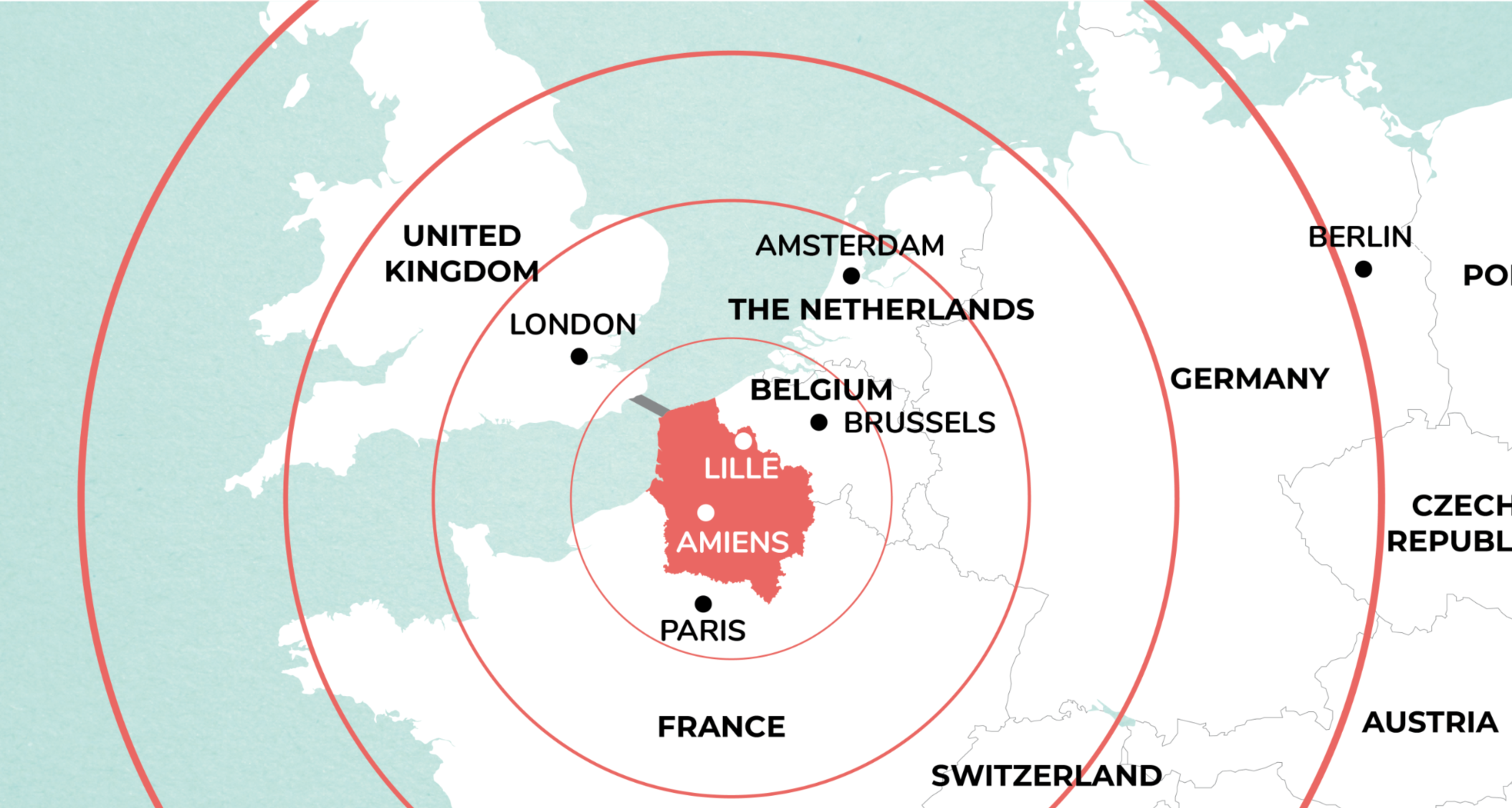
Europe map with a focus on Lille

Do you want to access the EU market more easily?

Discover how our Cross-Channel experts can support you
We create tailored support to give you concrete solution to access the EU market and fast-track your development.
#1Express your needs
#2 We contact you back shortly to discuss your needs further
#3We put you in touch with the right contacts
Get in touch with our experts
Europe map with a focus on Lille

From AI hype to real use cases: lessons from the Franco-British construction event in October 2026

The event held in Lille on 6 October 2026 focused on the Architecture, Engineering, Construction and Operations sector. Its starting point was deliberately practical: despite the acceleration of AI since 2024, adoption in construction still faces challenges around data, company culture and operational processes.

Organised by the Franco-British Data Society with Nord France Invest, La Cité de l’IA, ADIM Hauts-de-France and VINCI Construction, the event brought together French and British perspectives from construction, architecture, technology and digital transformation.

Speakers included representatives from VINCI Construction France, Ramery, A26 architectures, KEURK, NAME architecture and UK-based Virtual Viewing.

Three key takeaways emerged from the discussions:

  • AI is already supporting practical business tasks. Architecture firms are using AI to check planning regulations, explore design options and generate visualisations. Others are developing in-house applications to read architectural plans, produce preliminary cost estimates and support client decision-making.
  • Data remains the foundation for wider adoption. While digitalisation has created opportunities to experiment with AI, gaps remain in the flow of information between designers, contractors and building operators. Better data continuity is essential if AI is to become more deeply embedded in construction processes.
  • The next step is industry-specific AI. Beyond general-purpose tools for document analysis and reporting, companies are looking to develop applications that draw on their own data and accumulated expertise. The aim is to improve project planning, anticipate risks and make better operational decisions.

What makes Hauts-de-France an AI ecosystem?

Research, digital skills and innovation networks in Hauts-de-France

Hauts-de-France already has a substantial digital economy. An EY study commissioned by EuraTechnologies and regional partners identified 17,522 digital companies and 45,750 digital jobs in 2021, with 1,285 additional jobs created over the previous year. The study also found that 95% of the region’s digital companies were SMEs.

The regional research base includes the Inria Centre at the University of Lille. Inria reports 15 research teams and around 360 people, including more than 300 scientists, with close links to regional companies and the wider university ecosystem. Its activities include machine learning, data science, privacy-preserving AI and other digital technologies.

EuraTechnologies adds another layer to the ecosystem through startup incubation, acceleration, international programmes, AI training and links with universities and major companies. Across its five Hauts-de-France sites, it operates programmes covering fields including Industry and Robotics, PropTech, Cybersecurity, FinTech and e-commerce.

World map with focus on hauts-de-france

Hauts-de-France : an ecosystem focused on practical AI use cases

La Cité de l’IA (A hub dedicated to Artificial Intelligence) has a different role: helping companies understand, experiment with and integrate AI into their operations. Its activities include professional training, business and technology clubs, peer exchanges, webinars and events focused on real use cases. Its own presentation reports 150 members connected to a network of around 2,000 companies, while its AI Summit in Lille has brought together around 1,200 participants.

That focus matters for AI companies entering a new market. The potential customer base is not limited to other technology businesses. Hauts-de-France has established activities in manufacturing, automotive and mobility, logistics, retail, healthcare, energy, food production and construction. Each creates its own data, automation and operational challenges.

The October 2026 FBDS event illustrates this model: connect AI expertise with one established industry, identify concrete problems and create opportunities for exchange between technology providers and users.

AI

Computing infrastructure to grow AI businesses in Hauts-de-France

Hauts-de-France is also attracting large-scale investment in the computing infrastructure required to train, deploy and operate AI models. Several projects announced around the 2026 Choose France Summit point to a significant increase in regional capacity.

SoftBank announced a €45 billion investment in AI infrastructure in France, potentially rising to €75 billion, with plans for at least 3 GW and up to 5 GW of AI-dedicated data centre capacity nationwide. Part of this programme is concentrated in Hauts-de-France, alongside a partnership with Schneider Electric to manufacture data centre power modules at the Port of Dunkirk.

Brookfield is also expanding its AI infrastructure programme in France. Its first planned AI hubs include E-Valley in Northern France, where the group expects at least 300 MW of initial capacity and potentially up to 1 GW. Together with two other sites identified in the region, Brookfield says the Northern France cluster could exceed 2 GW of AI infrastructure capacity.

Through Brookfield-owned Data4, this investment is already taking physical form. Data4 confirmed a €5 billion campus in Escaudain, with four next-generation data centres designed to meet growing European demand for cloud and AI computing. The company cites access to low-carbon energy, talent and the region’s position between the major data exchange markets of London, Paris, Amsterdam and Frankfurt among the reasons for selecting the site.

Nebius is adding another 240 MW of dedicated AI capacity near Lille. The AI cloud company is developing a purpose-built AI factory in Béthune as part of its wider European infrastructure expansion.

Together, these projects add a new layer to the Hauts-de-France AI ecosystem: large-scale computing capacity alongside research, digital skills, business networks and industrial AI users.

What can Hauts-de-France offer a UK AI company?

For a UK AI startup or scale-up, entering France does not necessarily begin with setting up a subsidiary. The first requirement may simply be finding the right market, partners and users. Depending on the business model, Hauts-de-France can provide several entry points:

  • Market validation: meet companies in sectors where AI is already being tested or deployed.
  • Business development: build relationships with potential industrial or service-sector users.
  • Technology partnerships: connect with digital companies, innovation hubs and research teams.
  • Talent: explore recruitment and collaboration opportunities within the regional tech and academic ecosystem.
  • Infrastructure: understand the cloud, hosting and computing environment available for data-intensive projects.
  • Local presence: assess whether a French operation could support wider development in France and the EU.

The combination is particularly relevant for companies selling applied AI. Access to potential users can be as important as access to other technology companies.

French and british flags

How the UKBC Lille helps UK AI companies access the ecosystem

Navigating a new ecosystem can be difficult from the UK, particularly when the first question is simply: who should we speak to?

The UK Business Centre Lille provides British companies with a practical entry point into Lille, Hauts-de-France and the French market. The team can help clarify a company’s objectives and connect it with relevant public and private contacts, from business and innovation networks to sector specialists and organisations supporting local development.

For an AI company, that might mean identifying potential ecosystem partners, understanding the regional market, accessing relevant sector networks or exploring the practical requirements of establishing operations in France.

The objective is simple: give UK companies direct access to the right people before they commit time and resources to the next stage of their French market development.

Are you a UK AI company exploring opportunities in France? Discuss your project with our Cross-Channel experts.

UKBC Lille team
(+33) 3 53 32 00 54 Contact us